JTTP 2026
Results of the 27th Jeu de temps / Times Play
Artists and Submissions | Events | Awards | Jury
Recent works by young and/or emerging electroacoustic artists from or living in Canada are celebrated in JTTP 2026, the 27th edition of Jeu de temps / Times Play coordinated by the Canadian Electroacoustic Community (CEC).

Jeu de temps / Times Play (JTTP) is an annual project aimed at supporting and encouraging new works by young and/or emerging electroacoustic artists from or living in Canada. A diverse international jury adjudicates and selects the prize-winning works and award recipients. For each edition of the project, a series of events are coordinated featuring selected JTTP works, including radio broadcasts of JTTP submissions and performances of the selected works in concert by our Project Partners in Canada and abroad. Cash and prizes are awarded to the creators of the top-placing works and the thematic award recipients, and submissions are featured on these pages and in Sonus, the CEC’s online Jukebox for electroacoustic and related practices.
Prizewinners and Thematic Award Recipients
It is with great pleasure that the CEC announces the results of JTTP 2026. Join us in celebrating the following electroacoustic artists, whose works have been selected by an international jury for JTTP 2026 Prizes and Thematic Awards. Listen to and view their works on this page while you read their biographies and programme notes.
JTTP Prizes
- Alex Brisson — A a Ba A ɓA Bɐ (2026 / 8:00)
- Maurice-Gaston Du Berger — Noir de Mars (2026 / 8:40)
- Nicholas Ma — Assembly Line Apparitions (2025 / 6:30)
- [ex æquo] AC Riznar — filandre (Video - 2025 / 7:00)
- [ex æquo] Hugo Menchi — Ourobors (2026 / 12:50)
Thematic Award Recipients
- Hildegard Westerkamp Award for soundscape and sound installation
Arash Famiilirani — Misophonia (2025 — 15:00) - Micheline Coulombe Saint-Marcoux Award for self-identified female or non-binary electroacoustic artists
Yilin Wang — Echo of Gamelan (2023 — 11:47) - Jean Piché Award for videomusic, new media and creative coding
AC Riznar — filandre (Video — 2025 / 7:00) - Martin Gotfrit and Martin Bartlett Award for live electroacoustic practices
Alexandre Sasset-Blouin — Permutations (Vidéo — 2025 — 9:59) - Barry Truax Award for environmental or ecological audio practices
Alexandre Marchand, Rory Cogley — Flekete (2026 — 19:22) - jef chippewa Award for Indigenous cultural background
Cordell Collett — Limen (2026 — 3:47) - Yves Gigon Award for the most outrageous electroacoustic work
Lauré Lussier — Strange Symphony (2024 — 38:00)
Programme Notes and Biographies
Alex BRISSON — A a Ba A ɓA Bɐ (8:00 / 2026)
JTTP 2026 First Prize winner
This piece is composed primarily of cybernetic (or “feedback”) synthesis, where the sonic output intervenes as a causal agent on its origin. This technique is particularly interesting for the generation of sound objects possessing rich and complex timbres. The piece adopts a frank and causal musical language, where impulses trigger stases, phrases, suspensions, and surprises.
The concept of feedback is equally present in the organizational structure of the piece as a whole. At first, motifs appear to be singular and eclectic but soon become recurrent, repeat themselves with new functions or roles, announce a future section, or reappear completely transformed. Entire past sections are fused and imprinted onto new sections to recall familiar entities of the past, therefore creating an internal memory of the work itself in constant variation. This type of feedback, affecting the beginning with the end and the end with the beginning, finds its ambiguous finality through what has seemingly already been heard before.
The title references various musical forms that have used repetitive structures throughout history.
Alex Brisson is a composer of fixed-media acousmatic music and occasionally videomusic. He holds a bachelor of music in electroacoustic composition and sound creation from the Université de Montréal, where he studied under Martin Bédard and Nicolas Bernier, as well as Daniel Perez Hajdu while on exchange at ARTS² in Mons, Belgium.
His fixed-media compositional practice focuses primarily on abstraction and structural form. His choice of the fixed medium is explained by his interest in the discursive potential of digital media and its seemingly infinite plasticity and capacity for reorganization.
Brisson’s works have been presented in Belgium, Canada, and France.
Cordell COLLETT — Limen (3:47 / 2026)
Recipient of the 2026 jef chippewa Award for Indigenous cultural background
Limen explores the tension between the world we perceive and the world we overlook. While grounded in bright harmonic language, the work is shadowed by textures that suggest uncertainty and distance. The piece reflects a state of fixed attention, where familiarity can obscure the subtle beauty that surrounds us. Moments of clarity emerge and dissolve, revealing a landscape that is both comforting and unsettling. In this way, Limen inhabits the threshold between wonder and indifference, inviting the listener to cross between them.
Cordell Collett is a Canadian electroacoustic composer and sound artist based in Alberta. His work explores the musical potential of recorded sound through field recording, spatialization, and digital signal processing, creating immersive sonic environments that blur the boundaries between documentation and composition. Currently completing a Bachelor of Music in Digital Audio Arts at the University of Lethbridge, he approaches electroacoustic music as a medium for exploring place, memory, and listening.
Drawing from a background in music production and audio engineering, Cordell’s compositional practice combines technical precision with experimentation. His works integrate field recordings, custom impulse responses, and multichannel diffusion to shape dynamic listening experiences, while his experience in studio production and sound design continues to inform his artistic voice. Collett’s electroacoustic work reflects an interest in the relationship between sound, space, and perception, transforming everyday sonic materials into expressive musical forms.
Maurice-Gaston DU BERGER — Noir de Mars (8:40 / 2026)
JTTP 2026 Second Prize winner
What tragedies might be unfolding beyond the reach of our gaze? In the darkness of our senses, a world lies in turmoil. Can we perceive some distant echo of it?
Guided, sculpted, then manipulated and transformed, it is the sound itself that stirs and takes shape, revealing worlds that until then had manifested only through the echo of their vibrations.
By playing with the degree of transformation of the sound sources — all acoustic — Noir de Mars offers a universe where the real and the improbable coexist: the valley of the strange is therefore never far away. Could there be birds on Mars?
Maurice-Gaston Du Berger, born in 1987. After studying composition with José Evangelista at Université de Montréal, he completed his Master’s degree in 2011 under the direction of Ana Sokolović. He regularly receives grants form Canada’s and Quebec’s Arts Council and. He also works with renowed ensemble such as Studio de musique ancienne de Montréal and Les voix humaines. Since fall 2024, he has been enrolled in digital music at the Université de Montréal’s Faculty of Music. In his work as a composer, Mr. Du Berger shows a great interest in words and language, paying particular attention to the different types of relationships between music and text.
Arash FAMIILIRANI — Misophonia (15:00 / 2025)
Recipient of the 2026 Hildegard Westerkamp Award for soundscape and sound installation
Misophonia is a sound work built entirely from the space between two analog tones produced by two acoustic instruments (Tar & Ney). Through processes of extreme time-stretching and layering, the subtle interactions between these tones are expanded into a dense sonic field where resonance, interference, and micro-fluctuations become the primary material.
The piece focuses on sonic phenomena that normally remain hidden within sound: beating patterns, harmonic friction, and small instabilities that arise when two frequencies exist in close proximity. By magnifying these micro-events over extended durations, the work transforms a minimal acoustic gesture into an immersive listening environment where vibration becomes almost tactile.
The title Misophonia — a term describing intense emotional responses to specific sounds—is used here metaphorically. Rather than referring to aversion, it suggests heightened listening and the psychological intensity that can emerge from sustained attention to subtle sonic details.
Presented through a focused listening context, the work invites the audience to enter a slow and intimate auditory space. By reducing the material to a simple interval, Misophonia reveals how minimal sound can unfold into complex textures and perceptual experiences through time.
Arash Famiilirani is a Montréal-based audiovisual artist, composer, sound artist, and guitarist whose work explores minimal sonic materials, expanding micro-events into immersive auditory experiences through structured layering and spectral manipulation. He holds a BFA in Electroacoustic Studies from Concordia University, with a practice rooted in creating acousmatic soundscapes and a passion for transforming sound into new textures and sensations. His work spans multiple genres and styles, exploring new sonic palettes and the relationship between concrete and electronic sources.
Lauré LUSSIER — Strange Symphony (38:00 / 2024)
Recipient of the 2026 Yves Gigon Award for the most outrageous electroacoustic work
Strange Symphony is the first of three acts of The Triptych Symphony, a three-act tale in which the Composer, in haste and cowardice, abandons his creations.
It is the first to emerge from this act of abandonment; a work left behind by its composer before reaching the stage. An illegitimate work, a “Bastard Song”, anticipated with a mix of disdain and quiet derision even before its first public hearing.
The music does not begin when we press “play”. It feels as though it is already there, a space we enter. Very quickly, the listener is no longer facing a piece, but drawn into a world.
This work is informed by an approach I refer to as Systema, in which autonomous textures coexist and interact within a shared musical space. Each follows its own trajectory within a pre-established form, while their interactions shape the internal dynamics and perceptual experience of the work.
Lauré Lussier is a Quebec composer whose approach lies at the intersection of electroacoustic and orchestral composition. With two bachelor’s degrees in music from McGill University and the University of Montréal, he has developed a musical language in which acoustic and electronic timbres merge within expansive narrative forms. He composes based on ideas that he then embodies in sound. The transformation of the sonic material thus becomes the driving force of the narrative. While his works can be experienced individually, they all belong to the same universe, where ideas, narratives, and sonic material extend from one composition to the next. Signed to Adventurous Music (Leipzig, Germany), he has released 11 albums. His works are broadcast on radio stations and streaming platforms across Europe and North America and have been praised by publications such as The Wire, Electronic Sound, Tunite Music, and SilenceAndSound.
Nicholas MA — Assembly Line Apparitions (6:30 / 2025)
JTTP 2026 Third Prize winner
Assembly Line Apparitions is an electroacoustic work made entirely from recordings of a solo cello. All material was captured in a session with a cellist, then edited, processed, and arranged into a fixed audio track. The title refers both to the mechanical groove that drives the piece and to the step-by-step transformation of acoustic recordings into electronic material. Like an assembly line, the piece was built in stages, from performance to editing to reconstruction with the ghost of the performer embedded in the final product.
Structurally, the piece mirrors a late-night factory shift. It moves between tightly looped rhythmic patterns and more abstract textures. In the middle section, the groove dissolves into sustained, spectral tones and metallic sounds, before returning in a denser, more distorted form.
Overall, though fully electronic, every sound originates from the cello. The piece explores how acoustic material can be reshaped through electronic processes while preserving traces of its source.
Nicholas Ma is a pianist-composer whose music explores a dialogue between rhythmic vitality, playful whimsy, and contemplative rigor. He has received four SOCAN Foundation Young Composer Awards, McGill’s Luba Zuk Piano Duo Composition Competition Prize, commissions from Esprit Orchestra and the Coalition for Music Education in Canada, research funding awards from SSHRC and FRQ, and composer-in-residence positions with McGill’s Schulich Singers, Chamber Music Area, and Saxophone Quartet. Nicholas holds a Bachelor’s degree from McGill University, where he double-majored in Piano Performance and Composition with a minor in Music Theory. His primary teachers include Marina Mdivani for piano and Eliot Britton, Melissa Hui, Jean Lesage, and Chris Paul Harman for composition. He is currently pursuing a Master’s in Composition at McGill with a full scholarship.
Alexandre MARCHAND, Rory COGLEY — Flekete (19:22 / 2026)
Recipients of the 2026 Barry Truax Award for environmental or ecological audio practices
«Flekete: fais-lé avec kessé t’as». An expression invented by Steiff, truly a lighthouse for a large alternative community in Québec and Europe. Steiff passed on in November 2025, leaving behind a fragrance of sweat and beer in the hearts of many, but mostly a strength to love, and a sensitive sight to the beauty of things. He introduced many people around me to forge, including a dear friend who has now made it a career and a creative life. This piece is an homage to Steiff and the ones he inhabits; it is a lullaby made of metal to encapsulate the living he bequeath to us all in his passing on.
Alex Marchand is a composer and musician. A native of Montréal, he has been playing the double bass since 2014 and the bass since his teenage years, teaching himself to play in various ensembles, always eager to reexamine his relationship with sound and music while exploring the boundaries of his creativity. In 2022, he founded the ensemble O:DOOZ, a multidisciplinary group blending dance, digital visual arts, and mixed media music that has opened up new creative horizons for him and inspired him in the field of digital music. In 2024, Alex joined the group Ensemble de Feedback Libre, where he immersed himself in the practice of noise music, deepening his desire to create and learn in the field of contemporary sound art. In 2025, he began his bachelor’s degree in electroacoustics at Concordia, dedicating more and more of his practice to experimental and electroacoustic music.
Rory Cogley is an ambitious young sound artist with a love for collaboration and an ever-expanding interest for all sonic expression. His current practice explores a love for metallophones (cymbals, bells, stray tools and equipment) and an interest in sampling and manipulating oral poetry.
Hugo MENCHI — Ourobors (12:50 / 2026)
JTTP 2026 Fourth Prize [ex æquo] winner
This work invites the listener into an inner landscape where the boundaries between consciousness, memory, and imagination gradually dissolve.
The opening sounds, reminiscent of inhalations and exhalations, act as a passage between the tangible world and the hidden spaces of the mind. Slowly, the listener is drawn into deeper territories where time seems to stretch and familiar landmarks begin to transform.
The tonal forms that traverse the piece evoke the stages of an initiatory journey. They accompany an encounter with buried regions of the self, where fragmented memories, lingering sensations, and persistent traces emerge, shaping the person we have become.
As the journey unfolds, moments of ascent offer brief glimpses of clarity—a breath of air before another descent. Yet the depths continuously call the traveler back, inviting further exploration into increasingly intimate and elusive spaces.
Like the serpent that devours its own tail, the symbol of the Ouroboros, the end meets the beginning. Memories, present perceptions, and revelations arising from the subconscious intertwine within a continuous cycle. What has been experienced remains, transformed.
How far are you willing to venture into the furthest reaches of your own mind?
It is toward this inner realm that Ouroboros guides you.
The human and sonic resonances he carries—and which are dear to him—are felt during every performance, evoking memories of those vivid moments.
Sounds with percussive tones, rhythms that are both energetic and full of sensitivity: this is what Hugo’s musical world offers.
Drawing on his training in electroacoustics and a keen interest in field recordings, he combines these elements into a unique musical journey.
His curiosity and passion for discovering new atmospheres have allowed him to expand his experience on numerous stages across Europe, North Africa, and North America.
He also co-founded and launched the Insideout platform in March 2020. During the pandemic, it was essential for him to continue exploring this concept of exchange and workshops, where artists from all over the world could, like him, stay connected and share their passion for music creation.
In this vein, he co-founded the label SOAME Records with Oxyde B, with the goal of offering sonic journeys and a sense of letting go, while awakening our sense of hearing.
Moving between live performance, immersive composition, and spatialized sound, Hugo Menchi approaches music as a vast laboratory for research and escapism.
He is currently furthering his studies at the Montreal Conservatory of Music and Dramatic Art, in the electroacoustic department, under the guidance of Martin Bédard and Louis Dufort.

AC RIZNAR — filandre (Video — 7:00 / 2025)
JTTP 2026 Fourth Prize [ex æquo] winner and recipient of the 2026 Jean Piché Award for videomusic, new media and creative coding
n.f.
1. 1.
Long and tough fiber (meats, vegetables).
2. 2.
Spider’s thread that flies in the air (Virgo’s thread).
who does not want to leave the matter
that merges into otherness
that hides within oneself,
tough and agile
fragile and volatile
AC Riznar is a Montréal based musician, composer and visual artist, as well as singer-songwriter. Interested by textures, dream-like superposition of images and narratives, involving shot scenes/recordings and loops, they’re following the feeling of something being off, while embracing an intuitive-automatic creative process. Their practice is as well rooted in real-time processes including performance, movement and projection as in composition for fixed media. They’re studying creation and composition at the department of digital music at the University of Montréal.
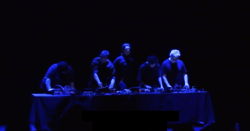
Alexandre SASSET-BLOUIN — Permutations (Video — 9:59 / 2025)
Recipient of the 2026 Martin Gotfrit and Martin Bartlett Award for live electroacoustic practices
Permutations is a work for No-Input Mixing Board quintet, exploring an feedback, noise, and controlled instability. Based on repeated and continuously transforming energetic trajectories, the piece relies on the gradual exchange of movements between performers, generating new permutations in each section. Although structured through graphic notation and written sequences, the work retains the unpredictable nature of chaotic electronic systems, making every performance a unique variation.
Alexandre Sasset-Blouin is a composer and sound artist from Tiohtià:ke (Montréal). His works and installations investigate acoustic and synthetic sounds transformed through transduction, amplification, and feedback. He uses modular synthesizers, as well as DIY devices that combine analog and digital technologies with recycled materials, to probe the transitions among the physical, electronic, and digital realms. As a composer and performer, he shapes harsh, noisy, and distorted sounds into composed and organized forms, often created for collaborative performances. Currently studying for a master’s degree at the University of Montréal under the direction of Nicolas Bernier, his research focuses on new approaches to electronic and mixed music notation. His research is supported by a scholarship from the Social Sciences and Humanities Research Council of Canada.
Yilin WANG — Echo of Gamelan (11:47 / 2023)
Recipient of the 2026 Micheline Coulombe Saint-Marcoux Award for self-identified female or non-binary electroacoustic artists
Echo of Gamelan is a spatial electroacoustic work created from gamelan improvisation, field recordings, and Ambisonic processing in Max/MSP. The piece explores the relationship between a localized instrumental source and an expanded artificial acoustic environment, allowing the original gamelan sound and its processed spatial reflections to coexist, separate, and merge across the listening field.
The work was developed through a custom Max/MSP Ambisonic patch designed for live processing, panning, encoding, and decoding. Gamelan improvisations were recorded, spatialized, and re-recorded through a surround loudspeaker environment, while field recordings of water and birds provide an additional environmental layer. Rather than following a traditional score-based process, the piece organizes recorded and processed sound materials into a shifting spatial form, moving between real and surreal acoustic environments.
The composition reflects an interest in auditory scene perception, spatial listening, and the way listeners imagine sources, distances, and environments through sound. In this work, gamelan resonance becomes both an instrumental trace and a spatial memory, echoing through a constructed electroacoustic space.
Yilin Wang is a pianist, composer, and multimedia artist whose creative practice grows from more than a decade of professional sound production. Before focusing on composition, she worked as a senior audio engineer at Hunan Broadcasting and Television Station in China, with extensive experience in recording, sound design, live music broadcast, and immersive audio production.
Her work spans contemporary composition, electroacoustic music, spatial audio, and audiovisual practice, often combining acoustic instruments, processed sound, fixed media, live electronics, and generative visual systems. Her work has been presented through Arraymusic Composer Workshop, LunART Festival Composers Hub, Tuckamore Festival, CompoCon with Standing Wave, UNESCO City to City PLAY!, and American Wild Ensemble. Wang holds an MA in Music Technology from the University of York and an MMus in Composition with a specialization in Music Cognition from Western University. She is currently pursuing a DMA in Composition at the University of Missouri—Kansas City.
Jury
This year’s international jury was comprised of 5 individuals with a variety of artistic backgrounds, experiences and interests.
Gilles Gobeil (Montréal, QC)
Dorothy E. Hindman (Miami, USA)
Etienne Mason (Brooklyn, USA)
Rick Nance (Leicester, UK)
Pauline Patie (Montréal, QC)

Social top