[Jeu de temps / Times Play 2026]
Artists and Submissions
27th Jeu de temps / Times Play
Results | Artists and Submissions | Events | Awards | Jury
A total of 42 recent works were submitted to JTTP 2026. Here you can read the programme notes and artist bios for all submissions or just sit back and enjoy the pieces — acousmatic and videomusic works, and more!
Artists
Charles BAILLARGEON
Luke BLACKMORE
Ricardo BOULLOSA
Nicolas BOURGEOIS
Alex BRISSON
Melike CEYLAN
Cordell COLLETT
Piper CURTIS
Julie DELISLE
Maurice-Gaston DU BERGER
Graeme DYCK
Arash FAMIILIRANI
Owen GRUNAU
Nolan HILDEBRAND
Mehrdad JAFARI RAAD
Artur KIVILAHT
Hubert LAMARRE
Keon Ju Maverick LEE
Leon LOUDER
Lauré LUSSIER
Nicholas MA
Alexandre MARCHAND, Rory COGLEY
Hugo MENCHI
Mikaël MOLLIEX
Marco NERI
Heather NICOL
Timo PEHKONEN
Renée QIN
Omar REYNA
AC RIZNAR
Eliot ROBY
Alexandre SASSET-BLOUIN
Michele SELVAGGI
Ashley SEWARD
Edith SKEARD
Samuel SOARES
Findlay SONTAG
Simon ST-JULES-AILLAUD
Aurélie THÉROUX SÉNÉCAL
Matthew Carl TODD
Yilin WANG
Submissions
Elisabete ALMEIDA — Vida (19:32 / 2026)
This composition was created for a dance-theater piece.
elisabete, known by her stage name Mona Mojo, is a multidisciplinary performer combining avant-garde jazz vocals, improvisation, contemporary dance, and circus acrobatics. Her work explores the voice as a physical and emotional instrument, often blending spontaneous vocal improvisation with movement and theatrical expression. Her artistic practice integrates jazz vocal training, experimental performance, and physical theatre, creating immersive performances that merge sound, movement, and improvisation.
Charles BAILLARGEON — Broke the Floor (9:16 / 2025)
My first ever full-length electroacoustic piece, it’s about trying to balance too many things at once and the building of stress until total collapse.
Montréal, who’s studying for a BAC in Musique Numérique. My eventual goal with my music is to combine elements of pop with the rich and texturally dense sound of electroacoustics. My work is inspired by LCD Soundsystem, Imogen Heap, James Blake and Quadeca, for their intuitive and intricate use of electronics.
Luke BLACKMORE — Le Flûteur (8:19 / 2026)
Le Flûteur is a fixed-media meditation on automation, machine/human interaction, and the dichotomy between live performance and recorded musical material. The work is inspired by the sculpture of the same name first showcased in 1738 by French inventor Jacques Vaucanson. The sculpture consisted of an automaton, or android, which was controlled through a series of mechanical processes hidden in the large platform on which the automaton sat. Using a real flute being controlled by the automaton, Le Flûteur could play twelve different melodies by blowing air through constructed lips, articulating with a valve-controlled tongue, and covering the flute’s holes with mechanical fingers covered in organic human skin.
My composition makes exclusive use of pre-recorded flute samples which are distorted electronically to resemble the soundscape of pre-industrial machinery, such as those which operated Le Flûteur.
Luke Blackmore is a composer, saxophonist and improviser from St. John’s, Newfoundland and Labrador. He currently studies composition with a minor in Jazz at Memorial University in St. John’s. Luke’s composition portfolio contains a wide range of acoustic, electronic and acousmatic pieces, utilizing a wide variety of sources, from found sound to synthesized sound, as well as live sound manipulation. He has written for the International Institute for Critical Studies in Improvisation, the Newfound festival and others.
Ricardo BOULLOSA — The Underground CIty (6:14 / 2026)
The Underground City [2026] is a pseudo-soundscape of Montréal’s Metro and REM [Réseau Express Métropolitain], reimagining the familiar transit spaces into a hostile, uncanny, and mechanical ecosystem. The underground is not solely infrastructure, but a shared social space shaped by human connection and disparity.
During the winter of 2026, this piece was made under the tutelage of Barry Truax’s Octophonic Seminar. The seminar was taken for credit as an Independent Study at Concordia University.
A composer specializing in sound design, sound recording and electronic music composition for film, video games and installations.
Currently a studying electroacoustics at Concordia University.
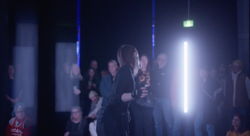

Nicolas BOURGEOIS — Rompre l'espace, corps fugace (Video — 19:51 / 2025)
Rompre l’espace, corps fugace is an electroacoustic performance assisted by a gesture recognition model. Interactive gloves designed by Nic Bourgeois capture the artist’s movements and translate them into a real-time sound composition, simultaneously generating light pulses revealing the performer’s movements momentarily. At the intersection of sound art, performance, and creative programming, this work explores the new paradigms of AI-assisted creation cautiously to amplify the presence of the queer body on stage. Drawing on the sensitivity of gesture, the audiovisual system seeks to transcend the body’s tangible value, circumvent its physical limits, and reveal a fluid interpretation of it. In this regard, the gloves are sensitive to different dimensions of movement, which are subsequently transmitted to the gesture recognition system that analyzes Nic’s performance and renders its interpretation in immersive sounds and lights. The music is experimental, oscillating between grainy textures, synthetic layers, and fragmented pulses, creating a constantly shifting soundscape. Rompre l’espace, corps fugace is an exploration of the musical potential of choreographic movement and the relationship between the body and the machine: a space where musical composition becomes embodied, and where new forms of presence emerge.
Rompre l’espace, corps fugace was presented at Ultrasons series (Université de Montréal), Compagnonnage IA (Cœur des sciences de l’UQAM, March 2025), Bric-à-brac X (Casa Obscura, February 2026), and Cabaret Neige (Centre d’art Jacques & Michel Auger, March 2026). The work was developed in a residency at CMMAS (Morelia, MX) in August 2025 thanks to financial support from Arrimage (Îles-de-la-Madeleine Cultural Development Fund), La Fabrique culturelle, LOJIQ, and the Conseil des arts et des lettres du Québec (CALQ).
Nicolas Bourgeois is an electroacoustic artist with a practice rooted in the performing arts who strives to bring forth queer realities through live pieces that redefine the relationship between movement and the audiovisual landscapes presented. Using the body as the primary object of creation, they explore how it can transform and interact with its environment. Bourgeois’ creative process, situated at the intersection of sound experimentation and contemporary dance, gives rise to works that are both deviant and intimate, utilizing sensors integrated into musical algorithmic systems. Originally from the Magdalen Islands (QC), Nicolas has been studying electroacoustics at Université de Montréal (Tiohtià:ke / Mooniyang) since 2022.
Alex BRISSON — A a Ba A ɓA Bɐ (8:00 / 2026)
This piece is composed primarily of cybernetic (or “feedback”) synthesis, where the sonic output intervenes as a causal agent on its origin. This technique is particularly interesting for the generation of sound objects possessing rich and complex timbres. The piece adopts a frank and causal musical language, where impulses trigger stases, phrases, suspensions, and surprises.
The concept of feedback is equally present in the organizational structure of the piece as a whole. At first, motifs appear to be singular and eclectic but soon become recurrent, repeat themselves with new functions or roles, announce a future section, or reappear completely transformed. Entire past sections are fused and imprinted onto new sections to recall familiar entities of the past, therefore creating an internal memory of the work itself in constant variation. This type of feedback, affecting the beginning with the end and the end with the beginning, finds its ambiguous finality through what has seemingly already been heard before.
The title references various musical forms that have used repetitive structures throughout history.
Alex Brisson is a composer of fixed-media acousmatic music and occasionally videomusic. He holds a bachelor of music in electroacoustic composition and sound creation from the Université de Montréal, where he studied under Martin Bédard and Nicolas Bernier, as well as Daniel Perez Hajdu while on exchange at ARTS² in Mons, Belgium.
His fixed-media compositional practice focuses primarily on abstraction and structural form. His choice of the fixed medium is explained by his interest in the discursive potential of digital media and its seemingly infinite plasticity and capacity for reorganization.
Brisson’s works have been presented in Belgium, Canada, and France.
Melike CEYLAN — Voice Station I (12:00 / 2021)
Voice Station I (2021) is a fixed-medium radio piece composed solely of recorded human voices. It evokes the casual act of radio dialing by presenting a wide range of vocal gestures and textures that loosely resemble sounds associated with radio broadcasting. Each station catalogues distinct timbres of disembodied radio voices, transformed and extended beyond syntax.
Voice Station I is the first work of the radio art portfolio of the same name that I developed as part of my doctoral research.
Cordell COLLETT — Limen (3:47 / 2026)
Limen explores the tension between the world we perceive and the world we overlook. While grounded in bright harmonic language, the work is shadowed by textures that suggest uncertainty and distance. The piece reflects a state of fixed attention, where familiarity can obscure the subtle beauty that surrounds us. Moments of clarity emerge and dissolve, revealing a landscape that is both comforting and unsettling. In this way, Limen inhabits the threshold between wonder and indifference, inviting the listener to cross between them.
Cordell Collett is a Canadian electroacoustic composer and sound artist based in Alberta. His work explores the musical potential of recorded sound through field recording, spatialization, and digital signal processing, creating immersive sonic environments that blur the boundaries between documentation and composition. Currently completing a Bachelor of Music in Digital Audio Arts at the University of Lethbridge, he approaches electroacoustic music as a medium for exploring place, memory, and listening.
Drawing from a background in music production and audio engineering, Cordell’s compositional practice combines technical precision with experimentation. His works integrate field recordings, custom impulse responses, and multichannel diffusion to shape dynamic listening experiences, while his experience in studio production and sound design continues to inform his artistic voice. Collett’s electroacoustic work reflects an interest in the relationship between sound, space, and perception, transforming everyday sonic materials into expressive musical forms.
Piper CURTIS — la maladie (14:28 / 2026)
A brief homage to the late Éliane Radigue (January 24, 1932 — February 23, 2026).
I first learned of Éliane Radigue’s work during my studies in the electroacoustic program at Concordia University (2017-20). She was an early adopter of tape loops, tape feedback, and synthesizers, and composed the bulk of her body of work using the ARP 2500 modular synthesizer.
Radigue and other pioneering women of electronic music, like her studio mate Laurie Spiegel (to whom I have previously paid homage), have been so influential to my work, and so it felt appropriate to break my hiatus by paying tribute to her approach—a “slow, purposeful ’unfolding’ of sound” (wiki) (although mine is notably more impatient).
de maladie marks my reentry to the world of sonic experimentations, born out of a brief home confinement due to illness (likely a bout of COVID-19, and a reminder to mask up). The title is twofold, a simple reference to the fact that I am sick as I write this, and a wink at its utter lack of melody and the half-rhyme between the two words.
This piece was composed using waveform generators, digital effects, and tape.
Piper Curtis is a sound artist and experimental musician based in Montreal. Their practice is an ongoing exploration of sound as environment, meditations on the sonic relationship of colour and noise, and the intersection of noise and music. Piper weaves together partially improvised, textural soundscapes to transport listeners to a world of their making.
Julie DELISLE — Contrepoint thermodynamique (8:56 / 2026)
Inevitably, the universe is expanding and seeks to dissipate the heat it contains and produces. Consequently, its entropy is constantly increasing. This occurs through the formation of complex structures: molecules, materials, living beings, and communities, whose primary purpose is the dissipation of energy—a process that would be far more difficult, if not impossible, without them. This thermodynamic counterpoint is an exploration of the frictions, reactions, and resulting explosions, both on a cosmic scale and within the infinitely small. It presents different types of materials—velvety, rough, metallic, acidic, vaporous—and brings them into dialogue through increasingly rapid temporalities, culminating in the materiological fugue that concludes the piece.
Julie Delisle is a composer, multidisciplinary researcher specialized in audio technology and flutist. They studied at the Hochschule für Musik Freiburg and at the Conservatoire de musique de Montréal, earned a doctorate (PhD) in musicology from the Université de Montréal, and was a postdoctoral fellow at the Music Perception and Cognition Laboratory (McGill University). Their music is influenced by their research work on instrumental timbre, and their interest in sound design, Chinese martial arts and mathematics.
Maurice-Gaston DU BERGER — Noir de Mars (8:40 / 2026)
What tragedies might be unfolding beyond the reach of our gaze? In the darkness of our senses, a world lies in turmoil. Can we perceive some distant echo of it?
Guided, sculpted, then manipulated and transformed, it is the sound itself that stirs and takes shape, revealing worlds that until then had manifested only through the echo of their vibrations.
By playing with the degree of transformation of the sound sources — all acoustic — Noir de Mars offers a universe where the real and the improbable coexist: the valley of the strange is therefore never far away. Could there be birds on Mars?

Maurice-Gaston Du Berger, born in 1987. After studying composition with José Evangelista at Université de Montréal, he completed his Master’s degree in 2011 under the direction of Ana Sokolović. He regularly receives grants form Canada’s and Quebec’s Arts Council and. He also works with renowed ensemble such as Studio de musique ancienne de Montréal and Les voix humaines. Since fall 2024, he has been enrolled in digital music at the Université de Montréal’s Faculty of Music. In his work as a composer, Mr. Du Berger shows a great interest in words and language, paying particular attention to the different types of relationships between music and text.
Graeme DYCK — lullaby for a marsh (10:08 / 2026)
lullaby for a marsh is a binaural ambisonic composition centred on changing prairie wetlands. Based on recordings of a day-night shift in a northern transition wetland, Treaty 8 territory, the piece combines soundscape, granular, and instrumental approaches to collaborate with this ecosystem and to sit with the conflicted relationship between humans and our nonhuman kin of the region. Field recording as the wetland slips through chattering dusk into quiet is an experience of both joy and grief, as it calls one to consider the many scales at which ecologies fall silent, whether temporarily or permanently, whether through their own cycles or human injury. The piece dwells in the loss of kin to wetland drainage and ecological crises across the prairies, kin we’ve hardly gotten to know. It also celebrates these kin, our co-sounders and co-creators. I am grateful for the opportunity to listen on these lands as a settler, lands whose peoples have also suffered the imposed silences of colonial violence.
Graeme Dyck is a Saskatchewan sound artist, writer and scholar whose practice disregards disciplinary and mediatic boundaries. They have undertaken interdisciplinary work between music, mathematics and philosophy, and won Canadian competitions for fiction and nonfiction. Graeme holds a BMus, a BSc in Mathematics and a certificate in jazz from the University of Saskatchewan, and has recently finished an MA in electroacoustic composition and sonic art at the University of Birmingham (UK).
Arash FAMIILIRANI — Misophonia (15:00 / 2025)
Misophonia is a sound work built entirely from the space between two analog tones produced by two acoustic instruments (Tar & Ney). Through processes of extreme time-stretching and layering, the subtle interactions between these tones are expanded into a dense sonic field where resonance, interference, and micro-fluctuations become the primary material.
The piece focuses on sonic phenomena that normally remain hidden within sound: beating patterns, harmonic friction, and small instabilities that arise when two frequencies exist in close proximity. By magnifying these micro-events over extended durations, the work transforms a minimal acoustic gesture into an immersive listening environment where vibration becomes almost tactile.
The title Misophonia — a term describing intense emotional responses to specific sounds—is used here metaphorically. Rather than referring to aversion, it suggests heightened listening and the psychological intensity that can emerge from sustained attention to subtle sonic details.
Presented through a focused listening context, the work invites the audience to enter a slow and intimate auditory space. By reducing the material to a simple interval, Misophonia reveals how minimal sound can unfold into complex textures and perceptual experiences through time.
Arash Famiilirani is a Montréal-based audiovisual artist, composer, sound artist, and guitarist whose work explores minimal sonic materials, expanding micro-events into immersive auditory experiences through structured layering and spectral manipulation. He holds a BFA in Electroacoustic Studies from Concordia University, with a practice rooted in creating acousmatic soundscapes and a passion for transforming sound into new textures and sensations. His work spans multiple genres and styles, exploring new sonic palettes and the relationship between concrete and electronic sources.
Owen GRUNAU — Via Hardness (11:20 / 2026)
Nolan HILDEBRAND — Amygdala Hijacker (13:06 / 2026)
Amygdala Hijacker is a work of post-acousmatic music composed for 5th-order ambisonics during a residency at the Spatialization and Interactive Research Lab (SPIRAL) at the University of Huddersfield. The composition is a musical experiment that explores the acoustic startle response (ASR) and Pavlovian conditioning.
In animals, including humans, the startle response is a largely unconscious defensive reaction to sudden or threatening stimuli, such as loud noises or sharp movements, and is generally associated with negative affect. I was inspired by a scientific article in which researchers examine the effects of the ASR in rats. High-volume bursts of white noise were used to study how the ASR can be attenuated through habituation and repetition, as well as enhanced through fear conditioning. In these experiments, neutral stimuli were repeatedly paired with the unconditioned stimulus that triggered the ASR.
The idea of conditioning recalled the classic Pavlov’s dog experiment. Russian physiologist Ivan Pavlov demonstrated that an unconscious, automatic biological response could be triggered by a previously neutral environmental cue through repeated association.
The title of the work references these conditioning experiments and the music’s aim to tap into the listener’s “lizard brain,” exploiting automatic biological responses and conditioned expectations.
Nolan Hildebrand is a composer and noise artist based in Toronto. Nolan’s music explores conceptual and physical extremities to create intense and engaging music. His musical output spans graphic scores, classical ensembles, electroacoustic and acousmatic music, and performance in an experimental solo noise project dubbed BLACK GALAXIE. Nolan’s music has been performed around the world including Darmstädter Ferienkurse, International Computer Music Conference (ICMC), Forum Wallis, and Bang on a Can LOUD Weekend. He has had opportunities to work with the Winnipeg Symphony Orchestra, ECM+ Ensemble, XelmYa Ensemble, Jonny Axelsson and Nick Photinos. Nolan completed his BMus in composition with Gordon Fitzell and Örjan Sandred at the University of Manitoba and an MMus in composition under the supervision of Eliot Britton at the University of Toronto, where he is currently pursuing a DMA with a focus on graphic notation and electroacoustic music under Kotoka Suzuki and Eliot Britton.
Mehrdad JAFARI RAAD — Orpheus at the Basement (6:30 / 2025)
Composed as part of the ongoing Upcycling Project, which explores ecological listening and the creative reuse of sounds recorded from found and discarded objects and urban environments, Orpheus at the Basement is a musical experiment. An attempt to make music and tell a story with microsounds (short sound objects with duration less than a second) recorded during pandemic. Here, I’m using various methods of audio montaging to bring these lifeless sound object to life. The main approach is by putting them together and sculpt a seemingly moving sound structure, and then by putting them together with a longer sound objects to create a sense of flow in the mix. Through these chaotic collages, a spectral cohesion emerges, a melody of life flowing through the veins of the once-dead.
Mehrdad Jafari Raad is a Toronto-based composer, performer, and media artist whose work spans concert music, film scoring, and electronic and electroacoustic practices. He holds a Doctor of Musical Arts in Composition from the University of Toronto. His music draws on traditional Iranian music alongside other musical traditions encountered through his studies, engaging contemporary classical idioms through a nuanced, narrative-driven approach.
His concert works have been performed internationally and have received numerous awards, and he has collaborated with a wide range of ensembles and performers, including the Bedford Trio, Rogue Duo, and the Brooklyn Chamber Orchestra. Alongside his concert practice, his film scores have been featured at major international festivals such as TIFF, VIFF, and San Sebastián.
In parallel with his work for the concert hall and screen, he collaborates with visual artists on interdisciplinary projects that explore multimodal forms and hybrid performance practices. His current work focuses on creating dialogues between sound and image, structure and improvisation. Across his practice, he engages themes of identity and fragmentation, cultural synthesis, power and resistance, and inner psychological landscapes.
Artur KIVILAHT — Four Sections for a Fender in Disrepair (4:50 / 2026)
Built from samples of a Fender Deluxe Reverb amplifier in disrepair, with brief appearances of birdsong, speech, and running water, this piece uses hum, hiss, and amplifier noise as part of its core material. Instead of treating the amplifier’s instability as interference, it lets it shape the form of the work. Across four connected sections, the music moves from distance into pressure, then into a softer field of blur and distortion, before arriving at a more direct, driving release. Throughout, the amplifier is heard not only as a source of tone, but as a worn and familiar object carrying traces of age, use, and memory.
Artur Kivilaht is a composer and guitarist whose work bridges composition and performance. His creative practice has been supported through collaborations with the Canada Council for the Arts, the Manitoba Arts Council, and the Screen Composers Guild of Canada. He trained in music composition and performance at the University of Manitoba, later continuing his studies in composition at Humber College and completing the SCGC mentorship program. As a performer, Artur has toured with the Broadway musical “Chicago” and with Princess Cruises throughout the Americas, experiences that continue to inform his versatile and collaborative approach to music-making.
Hubert LAMARRE — st-frédéric 46.28 -70.97 (5:25 / 2025)
See the French note
Keon Ju Maverick LEE — Resonance and Depth (8:56 / 2025)
This immersive electronic acousmatic work interweaves live percussion with an ever-changing generative ambient field. The piece explores timbre spatialisation as a musical process, allowing sound colour, resonance, rhythm, pitch, and spatial motion to unfold as a single evolving form.
The work operates on two interconnected scales. At the macro level, a generative layer shapes the overall atmosphere through density, harmonic drift, gradual transformation, and long spatial gestures. At the micro level, rhythmic interplay emerges from short transients, resonant chromatic strikes, bell-like attacks, and percussive fragments. These materials form an avant-garde percussion palette, extended through microtonal stochastic pitch shifting that produces unstable pitch inflections, spectral blurring, and subtle harmonic deviations. As a result, percussive attacks are not treated only as rhythmic events, but as resonant materials that shimmer, decay, recombine, and expand into a fluid timbral field.
Spatially, the piece is composed through object-based 3D spatialisation. Each sonic element is treated as an autonomous sound object whose position, trajectory, distance, and perceptual qualities evolve over time. Rather than fixing the work to a single loudspeaker arrangement, the spatial scene can be re-rendered across different listening environments. The original version was developed for an immersive 93.5-speaker dome setup and is presented here as a binaural stereo rendering, preserving cues of height, proximity, orbit, diffusion, and depth. For multichannel presentation, the work can be reimagined and diffused into a new spatial configuration while retaining its core sonic identity.
The form traces an arc from resonance to depth. Bright gestures and luminous metallic colours gradually dissolve into low tones, subharmonic pressure, and widened spatial motion, drawing the listener from active rhythmic energy into a suspended immersive field.
Keon Ju Maverick Lee, also known as Keon la Nocturne (pronouns: he/him/they), is a Korean-Canadian electroacoustic and acousmatic artist-researcher, electronic percussionist, and composer whose immersive works foreground sound diffusion, spatial motion, and timbre. Working across loudspeaker arrays and binaural headphone environments, he approaches these formats as complementary listening spaces and advocates for ethical, responsible, and artist-in-the-loop creative AI systems.
He is a research-creation PhD candidate at Simon Fraser University’s Metacreation Lab, where he develops co-creative musical AI agents and interactive performance systems for drums and percussion. His performances, installations, and collaborative projects have been presented in artist-residency and research-creation contexts at Montréal’s SAT, as well as at MusicAcoustica and MUTEK, with related project contributions appearing at Ars Electronica, SIGGRAPH, MUTEK, and the AI Music Song Contest, where his work was a Top 10 finalist in 2024.
He collaborates with colleagues at C4DM in London, CIRMMT in Montréal, and IRCAM in Paris, and has published on musical AI in venues including TISMIR, AIMC, and the NeurIPS Creative AI Track and workshops. Recently, his spatial music work was selected for the *petites formes* 2026 Acousmatic Composition Competition and the Musical Timbre Conference 2026, highlighting his co-creative research on timbral spatialization with spatial agents.
Leon LOUDER — Landline Heat (7:15 / 2026)
Landline Heat
FR: (rez-de-chaussée)
The 1987 Montréal flood: A sonic memoir
“Evoking natural processes feels like a useful way to make sense of a complicated beast like a city, but it is also an effective way to make power relations invisible.” — Leslie Kern
“All roads lead back to water” — R. Murray Schaefer
A basement is a ground floor’s memory. Unlike garages or sheds, externals dangling from the suburban mainframe, the basement of a rental flat is histories erased and rewritten but also data stacked on top of earlier traces, a jumble of codes. At the back of every kitchen, a door to the underground, gaping as if to say: “What do I know?” An outlet. A Jack.
The memory of a minor natural disaster returns in a tangle of sounds; the debris of the analogue era and warning signals of climate disaster and a disintegrating world order, the fragile pulse of an immigrant borough. A maelstrom of overlapping fragments, carrying memory and material forward into the present, a womb of fluid relationships; water, electricity, speech.
Lauré LUSSIER — Strange Symphony (38:00 / 2024)
Strange Symphony is the first of three acts of The Triptych Symphony, a three-act tale in which the Composer, in haste and cowardice, abandons his creations.
It is the first to emerge from this act of abandonment; a work left behind by its composer before reaching the stage. An illegitimate work, a “Bastard Song”, anticipated with a mix of disdain and quiet derision even before its first public hearing.
The music does not begin when we press “play”. It feels as though it is already there, a space we enter. Very quickly, the listener is no longer facing a piece, but drawn into a world.
This work is informed by an approach I refer to as Systema, in which autonomous textures coexist and interact within a shared musical space. Each follows its own trajectory within a pre-established form, while their interactions shape the internal dynamics and perceptual experience of the work.
Lauré Lussier is a Quebec composer whose approach lies at the intersection of electroacoustic and orchestral composition. With two bachelor’s degrees in music from McGill University and the University of Montréal, he has developed a musical language in which acoustic and electronic timbres merge within expansive narrative forms. He composes based on ideas that he then embodies in sound. The transformation of the sonic material thus becomes the driving force of the narrative. While his works can be experienced individually, they all belong to the same universe, where ideas, narratives, and sonic material extend from one composition to the next. Signed to Adventurous Music (Leipzig, Germany), he has released 11 albums. His works are broadcast on radio stations and streaming platforms across Europe and North America and have been praised by publications such as The Wire, Electronic Sound, Tunite Music, and SilenceAndSound.
Nicholas MA — Assembly Line Apparitions (6:30 / 2025)
Assembly Line Apparitions is an electroacoustic work made entirely from recordings of a solo cello. All material was captured in a session with a cellist, then edited, processed, and arranged into a fixed audio track. The title refers both to the mechanical groove that drives the piece and to the step-by-step transformation of acoustic recordings into electronic material. Like an assembly line, the piece was built in stages, from performance to editing to reconstruction with the ghost of the performer embedded in the final product.
Structurally, the piece mirrors a late-night factory shift. It moves between tightly looped rhythmic patterns and more abstract textures. In the middle section, the groove dissolves into sustained, spectral tones and metallic sounds, before returning in a denser, more distorted form.
Overall, though fully electronic, every sound originates from the cello. The piece explores how acoustic material can be reshaped through electronic processes while preserving traces of its source.
Nicholas Ma is a pianist-composer whose music explores a dialogue between rhythmic vitality, playful whimsy, and contemplative rigor. He has received four SOCAN Foundation Young Composer Awards, McGill’s Luba Zuk Piano Duo Composition Competition Prize, commissions from Esprit Orchestra and the Coalition for Music Education in Canada, research funding awards from SSHRC and FRQ, and composer-in-residence positions with McGill’s Schulich Singers, Chamber Music Area, and Saxophone Quartet. Nicholas holds a Bachelor’s degree from McGill University, where he double-majored in Piano Performance and Composition with a minor in Music Theory. His primary teachers include Marina Mdivani for piano and Eliot Britton, Melissa Hui, Jean Lesage, and Chris Paul Harman for composition. He is currently pursuing a Master’s in Composition at McGill with a full scholarship.
Alexandre MARCHAND, Rory COGLEY — Flekete (19:22 / 2026)
«Flekete: fais-lé avec kessé t’as». An expression invented by Steiff, truly a lighthouse for a large alternative community in Québec and Europe. Steiff passed on in November 2025, leaving behind a fragrance of sweat and beer in the hearts of many, but mostly a strength to love, and a sensitive sight to the beauty of things. He introduced many people around me to forge, including a dear friend who has now made it a career and a creative life. This piece is an homage to Steiff and the ones he inhabits; it is a lullaby made of metal to encapsulate the living he bequeath to us all in his passing on.
Alex Marchand is a composer and musician. A native of Montréal, he has been playing the double bass since 2014 and the bass since his teenage years, teaching himself to play in various ensembles, always eager to reexamine his relationship with sound and music while exploring the boundaries of his creativity. In 2022, he founded the ensemble O:DOOZ, a multidisciplinary group blending dance, digital visual arts, and mixed media music that has opened up new creative horizons for him and inspired him in the field of digital music. In 2024, Alex joined the group Ensemble de Feedback Libre, where he immersed himself in the practice of noise music, deepening his desire to create and learn in the field of contemporary sound art. In 2025, he began his bachelor’s degree in electroacoustics at Concordia, dedicating more and more of his practice to experimental and electroacoustic music.
Rory Cogley is an ambitious young sound artist with a love for collaboration and an ever-expanding interest for all sonic expression. His current practice explores a love for metallophones (cymbals, bells, stray tools and equipment) and an interest in sampling and manipulating oral poetry.
Hugo MENCHI — Ourobors (12:50 / 2026)
This work invites the listener into an inner landscape where the boundaries between consciousness, memory, and imagination gradually dissolve.
The opening sounds, reminiscent of inhalations and exhalations, act as a passage between the tangible world and the hidden spaces of the mind. Slowly, the listener is drawn into deeper territories where time seems to stretch and familiar landmarks begin to transform.
The tonal forms that traverse the piece evoke the stages of an initiatory journey. They accompany an encounter with buried regions of the self, where fragmented memories, lingering sensations, and persistent traces emerge, shaping the person we have become.
As the journey unfolds, moments of ascent offer brief glimpses of clarity—a breath of air before another descent. Yet the depths continuously call the traveler back, inviting further exploration into increasingly intimate and elusive spaces.
Like the serpent that devours its own tail, the symbol of the Ouroboros, the end meets the beginning. Memories, present perceptions, and revelations arising from the subconscious intertwine within a continuous cycle. What has been experienced remains, transformed.
How far are you willing to venture into the furthest reaches of your own mind?
It is toward this inner realm that Ouroboros guides you.
The human and sonic resonances he carries—and which are dear to him—are felt during every performance, evoking memories of those vivid moments.
Sounds with percussive tones, rhythms that are both energetic and full of sensitivity: this is what Hugo’s musical world offers.
Drawing on his training in electroacoustics and a keen interest in field recordings, he combines these elements into a unique musical journey.
His curiosity and passion for discovering new atmospheres have allowed him to expand his experience on numerous stages across Europe, North Africa, and North America.
He also co-founded and launched the Insideout platform in March 2020. During the pandemic, it was essential for him to continue exploring this concept of exchange and workshops, where artists from all over the world could, like him, stay connected and share their passion for music creation.
In this vein, he co-founded the label SOAME Records with Oxyde B, with the goal of offering sonic journeys and a sense of letting go, while awakening our sense of hearing.
Moving between live performance, immersive composition, and spatialized sound, Hugo Menchi approaches music as a vast laboratory for research and escapism.
He is currently furthering his studies at the Montreal Conservatory of Music and Dramatic Art, in the electroacoustic department, under the guidance of Martin Bédard and Louis Dufort.
Mikaël MOLLIEX — Premiers mots (8:29 / 2026)
Premiers mots explores the journey of a character searching for meaning. Through introspection, he becomes aware of the thoughts, feelings, and memories moving through him. As he dives into his past, he returns to the roots of his personality — back to early childhood, to the moment when the first words emerged. There, the adult reconnects with the innocence of the child, discovering language for the very first time. Premiers mots is a deeply personal and symbolic piece: an intimate ritual marking the transition into fatherhood.
Based in Montréal, Mikaël approaches sound as a living, expressive substance. He offers listening experiences that invite stillness.
At the crossroads of electroacoustic music, pop, sound design, and audio storytelling, each project offers a singular journey where sound shapes the landscape.
Themes arise from an observation of nature, the dynamics between people, and an intuition for what lies beyond the visible. Whether captured or imagined, sound is shaped, composed, and woven together to bring forth narratives that resonate beyond words.
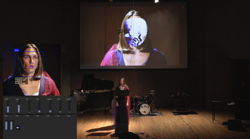
Marco NERI — Persona (Video — 11:30 / 2025)
Persona is an experimental performance that views singing as a way to figure out who we are in the world, emphasising the human body as a direct source of sound and identity. Instead of playing a character, the performer has to face the raw sensations of their own body, dealing with physical intensity in real-time. The score is a series of nearly impossible physical instructions that make the piece less about being “perfect” and more about the honest struggle to keep going, revealing a voice that is unique rather than just a practiced technique.
To make this happen, I built a digital environment where even tiny facial movements are magnified. A custom tracking system using JavaScript Node System and WebSockets watches the performer’s face to detect expressions like sadness or happiness. These expressions then trigger and warp live audio inside Max MSP, while Unity generates a digital mask that reacts and changes on screen in sync with the performer’s movements.
Marco Neri does not believe in reality anymore; he believes in art. His spiritual-magical thinking has taken him to create all kinds of fictional and dreamy audio sceneries. His music continually switches between electronic and acoustic elements and seeks to motivate the public to enjoy the ecstasy of sound. His music has been presented in Mexico, Canada, United States, Belgium, Cuba, Spain and France. He has collaborated for more than ten years with various contemporary dance companies, notably Ideatracciones Danza. In 2013 he co-founded the Onepanko youth orchestra in Mexico City, participating as a composer and producer. In 2015, he started the ARStudio music label, where as Director he brought to life more than 50 recordings of concert music by young musicians. He is currently exploring film scoring, having so far collaborated with directors from France, Canada and Mexico. Finally, in April 2022, he obtained his Master of Music Composition degree from the University of Victoria.
Heather NICOL — September Song (22:08 / 2021)
Heather Nicol is a Toronto-based artist whose practice includes immersive sound installation, sculpture, performance and participatory actions. Throughout her interdisciplinary practice, she has worked with actors, musicians, choreographers, educators and fabricators. Her site-specific interventions explore the architectural, sonic, historic and operational conditions of her locations. These include an outdoor interactive sound and environment installation created for the Bentway, Toronto, enormous concourse atriums such Brookfield Place, Toronto (Santiago Calatrava, Arts Brookfield Canada), and New York’s Winter Garden (Cesar Pelli, Arts Brookfield USA). Other site interventions include a former rail terminus (ZK/U, Berlin, and another, Eastern Terminal, Buffalo NY), a decommissioned theme park (Ontario Place, IN/FUTURE, Art Spin, Toronto), Chateau de Courannces (Milly, France), Toronto’s downtown transit hub Union Station (Nuit Blanche), a storage locker facility (Art Spin, Toronto), and a theatre (Harbourfront Center, Toronto). She has generated site-driven exhibition possibilities for her community as an independent curator / producer. She engaged thousands of audience at two Toronto programs, makingROOM, 2006, in a 30,000 square foot shuttered sweatshop, and Art School (dismissed), 2010, in a decommissioned public school. Both exhibition programs included scores of artists working across a wide range of disciplines. She has also curated exhibitions for galleries, including YYZ (Toronto), The John Paul Slusser (Michigan), Robert McLaughlin (Oshawa), and Critical Distance (Toronto). She has engaged with children, the elderly, migrant youth, and passers-by in a variety of interactive forums. In Toronto, a seventy performer “flash mob” was created in collaboration with choreographer Andrea Nann; participatory sound-making performance events have been presented in New York City, Ottawa and Berlin. She performed the role of “the Sweeper” in her immersive installation September Song.
Timo PEHKONEN — Bry (5:42 / 2026)
Bry is a work for six speakers using only sine waves. It explores the complex relationship between the arguably arbitrary 12-tone equal temperament tuning system and the seemingly natural phenomenon known as the harmonic series. All rhythmic beating occurs naturally without the addition of any applied effects. This particular work accepts the medium of speakers as they are, without trying to create any auditory illusions, in the same way Piet Mondrian might accept flatness.
Timo Pehkonen’s current style is explorative of pure sounds formed out of multilayered compositional techniques derived from a wide range of ideas. Some of these ideas include:
- the abandonment of emotion during the genesis of any given work and welcoming emotion with open arms upon its journey and fruition
- twelve-tone equal temperament application superimposed over harmonics (partials)
- time as a calculation amidst time as an experience
- minimalizing orchestration down to only sine waves and white noise
- inevitable accompaniment
- embracing “unwanted” sounds
- sound architecture
The (sub)conscious human response to the inner workings of our (un)natural surroundings is a key aspect in Pehkonen’s works. The attention to detail in the compositional process is often meticulously executed while the resulting music finds a way to loosen it’s hinges, giving the listener an opportunity to experience deep reflection.
He has an Honours Bachelor of Arts from Lakehead University (Thunder Bay, Ontario) and a Master of Music from University of Victoria (Victoria, British Columbia). He has studied composition under Darlene Chepil Reid, Aris Carastathis, Dániel Péter Biró, and Anna Höstman.
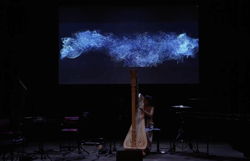
Renée QIN — Call From Afar (Video — 3:05 / 2026)
On a sailing trip, the captain lowered a hydrophone into the water, and for the first time, I heard whales live. Their voices rose through the hull of the boat from somewhere beneath us.
Whales have been singing for over 50 million years. In Call From Afar, their calls move alongside the harp, while abstract 3D forms, shaped by the whales’ voices, slowly evolve and dissolve. A rubber ball technique on the harp strings echoes whale calls directly, and at the end, the harp is left alone, attempting that voice one last time. The whales do not respond. The images scatter and fade.
For me, this piece is about what it means for a voice that has existed for millions of years to begin going unanswered.
Renée Qin is a Canadian harpist, composer, and multimedia artist whose work explores the intersection of sound, technology, and storytelling. Her music blends classical performance with real-time electronics, visual programming, and interactive technology. With a background in music and computer science, she creates works that expand the expressive potential of acoustic instruments through experimental sound design and digital media. Renée holds a B.A. in Music and Economics from Stanford University and is also pursuing a Master’s in Computer Science. She is an Artist Diploma fellow at the OAcademy Conservatory, where she also earned the Contemporary Collaboration Certificate. A 2024 recipient of CBC’s “30 Hot Classical Musicians Under 30,” her compositions reflect a commitment to pushing the boundaries of concert music and inviting audiences into multisensory, interdisciplinary experiences that reimagine the role of performer, instrument, and audience in a shared sonic space.
Omar REYNA — Non-predictable (47:00 / 2023)
Synopsis of piece: “Non-predictable” is one piece of a larger project called “An ocean roaming through the forest.” This project looks at turbulence as both a real physical phenomenon and a way to describe complicated situations in our everyday lives. A lot of the world around us is made up of moving flows, like oceans, rivers, wind and forest fires. When turbulence manifests in our daily existence, life becomes an ocean upon which we can easily flounder. “Non-predictable” is about exploring the sounds of turbulence in nature. Do the sounds of wind hitting trees or the tonal colours of moving water have emotions that fluctuate over time?
Omar Reyna is a Mexican-Canadian interdisciplinary artist who focuses on the intersection of research and the activity of making. Omar sees his art practice as creating worlds beyond the visible, bridging the real and imagined through the manipulation of physical and/or sonic materialities. Born in Mexico City and now residing in Yukon, Canada, Omar has studied visual communication, photography, sculpture, sound art, painting, and the philosophy of image. His work has been exhibited in various countries, including Canada, Argentina, South Korea, the United Kingdom, and the USA. Notably, Omar is a finalist (2023) and a long-listed artist (2025) for the Yukon Prize for Visual Art.
AC RIZNAR — filandre (Video — 7:00 / 2025)
n.f.
1. 1.
Long and tough fiber (meats, vegetables).
2. 2.
Spider’s thread that flies in the air (Virgo’s thread).
who does not want to leave the matter
that merges into otherness
that hides within oneself,
tough and agile
fragile and volatile
AC Riznar is a Montréal based musician, composer and visual artist, as well as singer-songwriter. Interested by textures, dream-like superposition of images and narratives, involving shot scenes/recordings and loops, they’re following the feeling of something being off, while embracing an intuitive-automatic creative process. Their practice is as well rooted in real-time processes including performance, movement and projection as in composition for fixed media. They’re studying creation and composition at the department of digital music at the University of Montréal.
Eliot ROBY — Fire Loon (9:46 / 2026)
This winter, I was asked to compose a soundscape piece in eight channels as part of Barry Truax’s soundscape composition course. Montréal’s keynote sound in February is thousands of vehicles in grey slush, so I opted to revisit recordings from my summer. Diving into a recording of a distant loon couple I made whilst lingering by the fire, Fire Loon unpacks and repackages this material while maintaining recognizability, augmenting pre-existing qualities of the sounds and painting a few new ideas into the picture. Imagine yourself by the fire, near the water.
Elyot Roby is a Canadian musician, producer and artist working with sound in Tiohtià:ke Canada. Hailing from an eclectic background of new wave, acousmatic, ambient and Atlantic folk music, Roby employs traditional musicianship with electroacoustic practices, seeking to open doors between sonic practices.
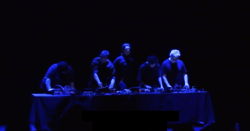
Alexandre SASSET-BLOUIN — Permutations (Video — 9:59 / 2025)
Permutations is a work for No-Input Mixing Board quintet, exploring an feedback, noise, and controlled instability. Based on repeated and continuously transforming energetic trajectories, the piece relies on the gradual exchange of movements between performers, generating new permutations in each section. Although structured through graphic notation and written sequences, the work retains the unpredictable nature of chaotic electronic systems, making every performance a unique variation.
Alexandre Sasset-Blouin is a composer and sound artist from Tiohtià:ke (Montréal). His works and installations investigate acoustic and synthetic sounds transformed through transduction, amplification, and feedback. He uses modular synthesizers, as well as DIY devices that combine analog and digital technologies with recycled materials, to probe the transitions among the physical, electronic, and digital realms. As a composer and performer, he shapes harsh, noisy, and distorted sounds into composed and organized forms, often created for collaborative performances. Currently studying for a master’s degree at the University of Montréal under the direction of Nicolas Bernier, his research focuses on new approaches to electronic and mixed music notation. His research is supported by a scholarship from the Social Sciences and Humanities Research Council of Canada.
Michele SELVAGGI — and their carcasses scattered over the sod (ii) (8:00 / 2025)
This work’s parent work was originally written with the intention of being about nothingness—nothingness as an abstract entity, nothingness as both filled space and void, and nothingness as an emotion embodied. As to be expected, the concept of “nothingness” is incredibly difficult to convey, especially through music, which already coerces a listener’s perception down a multitude of unpredictable paths, sometimes unrelated to the musical content at hand. After the parent work’s performance, I was drawn to treat this nothingness—or the intention of it—as a container, where the structures and schemes that defined the parent work could now be changed by different entities inside the confines of a new work.
Instead of being explicit in my approach to nothingness, I fixated on the idea of a “space” being gradually filled, and the process of this space collecting the residue/traces of material from sonic events over time. I was particularly inspired by a line in a self-written poem in which I describe the fallen carcasses of cicadas post summer-emergence as holding up to 17 years worth of “biological residue”, almost as if were a story of their development, only to be quickly absorbed by the soil upon which they reside; imagery of process, forgetting, and transmutation began to dominate my though process. I imagined an empty room that by the end of the piece is transformed by sound, and during the piece slowly begins to response differently to sound; in essence, as more sound passes through the space, the more the closed room is transformed, and the more the recurring sounds are themselves transmuted to eventually become unrecognizable—as if in a feedback loop.
This work utilizes self-made, adaptive feedback systems that were the product of three years of sonic research.
Three-time SOCAN Composer Award Winning composer Michele Selvaggi hails from the heart of downtown Toronto with strong Southern Italian roots and is currently based in Basel as a postgraduate student and freelance musician. Concerned deeply with the physiological and perceptual experience of music, notably driven by their own existential confrontation with time’s passage, Michele’s experimental work is intensely coloured by influences from their earlier engagement in the natural sciences, resulting in noisy sonic topographies and detailed electroacoustic environments that are often shaded by their daily life living with demanding anxiety and OCD. Just intonation, feedback systems, and soundscape are but a few ongoing fascinations that unusually tinge their approach to sound.
Michele has both received commissions from and recurrently collaborated with organizations scattered across Europe and North America, including the impuls Festival—at which they have premiered three chamber works—UdK Berlin, Museum Tinguely, Redshift Music, Arraymusic, Kamratōn Ensemble, the Eastman School of Music, the Canadian Music Centre, and the Canadian New Music Network. They were the resident Lead Composer for Green Room Sound Collective’s spectral-multimedia installation, “The Gallery”. Michele has also been the recipient of over 20 awards and prizes including SOCAN Foundation Composer Awards in both Chamber Music and Electroacoustic Music, the 2020 winner of Eastman School of Music’s 2020 International Call for Scores, as well as the Residency Prix CIME 2021, resulting in a fully-funded residency at the SME AMKP Studio for Electroacoustic Music in Krakow. Their music has been included in the 2024 Canadian Section’s official submission to World Music Days, shortlisted for a 2022 Red Jasper Award, and led to nomination for a 2021 Rhodes Scholarship.
In their most recent work, Michele has developed a body of research that explores what they coin as “sonic entropy”, culminating in a prize-winning thesis on Entropic Drift in musical systems at the Musik-Akademie Basel, which strove to unify the realms of arts and natural sciences by elaborating on their own scientifically-informed style. They are currently completing a series of 8 electroacoustic pieces commissioned by Basel-based performers, funded by the Nicati — de Luze Foundation.
Michele holds a Bachelor’s in Music Composition from the University of Toronto, as well as a Master’s in Music Composition from the Musik-Akademie Basel. They have studied primarily with Norbert Palej, James Rolfe, Bekah Simms, Darren Copeland, Casper Johannes Walter, and Volker Böhm, as well as taken lessons and masterclasses with Raven Chacon, Clara Iannotta, Chaya Czernowin, Francesco Filidei, Pierluigi Billone, Mark Andre, and Stefan Prins.
Ashley SEWARD — Mind Poop Supercut (6:30 / 2025)
Mind Poop Supercut, my first work for tape alone, combines several unrelated audio cues into a YouTube Poop-inspired maelstrom of fart jokes, video game lore, nu-metal karaoke, and early-aughts political angst. In creating Mind Poop Supercut, I tried to reflect the jumbled, cross-referential, and fixative patterns of my own neurodiverse thinking — and somehow, underneath everything, it’s also a twelve-tone composition which references multiple musical styles. Mind Poop Supercut holds the serious and the ridiculous in its hands and asks whether their differences matter in an age where every sound, image, and idea is melted down and subsumed into content for a homogenizing media ecosystem controlled by reactionary political elements. It’s a wonder I get anything done.
Ashley Renee Seward is a composer living and working in so-called Toronto, Canada. She is currently studying at the University of Toronto, and has recently finished a Master of Music in Composition at the University of British Columbia. Ashley exists in spaces between genres, genders, niches, and social-hierarchical positionalities and illuminates these tensions in her music. She enjoys writing for all instruments and ensembles, with a particular interest in small chamber ensembles and opera.
Ashley has written music for the Vancouver Symphony Orchestra, the Calgary Philharmonic Orchestra, Standing Wave Ensemble, Allegra Chamber Orchestra, and the Kensington Sinfonia, among others. In 2021, Ashley’s work “trypanophobia” for viola sola was awarded a runner-up prize in that year’s SOCAN Young Composers Competition. Ashley’s piece “Storms Over Camp Creek” was recorded in 2023 by the Kensington Sinfonia for their album Forces of Nature. In 2023, Ashley was among the first musical artists to be shortlisted for the Portfolio Prize. Ashley’s music has been lauded as “iconoclastic” and “conceptually intriguing” by various important composers.
When not composing, Ashley likes to play video games and plan out her Magic: The Gathering decks.
Edith SKEARD — Topia (23:58 / 2024)
Edie Skeard (they/them) is deeply inter-disciplinary — they are an artist, composer, and researcher working primarily within sound, sculpture, and philosophy. They are interested in desire paths, the physical mapping of duration, the temporary architectures of exhibition sites, and thinking through spaces that are rooted in consent and hospitality. Their practice is rooted in deep-noticing/listening, ecology, improvisation, granulation, critical approaches to field recording, and material practice. They use sound as a dense poetics — contemplating gestures of embodied time.
Edie is from Treaty 6, Saskatoon, Saskatchewan. They are currently based on unceded Lekwungen Traditional Territory — also known as Victoria, BC. They have their BA hons in Philosophy and a BFA in Visual Art from the University of Regina, Saskatchewan and hold an MFA from the University of Victoria.
Samuel SOARES — Quantity into Quality (6:40 / 2026)
Quantity into Quality is an electroacoustic composition incorporating the Abstract Expressionism movement from visual arts and Hegelian Dialectics from philosophy, more specifically the law of the transformation of Quantity into Quality.
This composition is a sonic interpretation of the 1975 Jack Bush painting Mauve Glissandi Displayed at the Musée des beaux arts de Montréal, I was able to recreate, with additive synthesis, the painting, visible in the spectrogram video.
The sounds were created and composed to relate visually, semantically and parametrically with the painting (each of them forming a distinct section of the piece.)
Concepts used to compose: Gestalt theory, tension and release, themes and variations, additive synthesis, background vs foreground, splitting of the sound
Sound sources: Modular synthesizers, piano and voice
Some quick notes on the main themes of each section:
- The main theme of section 1 was created by impulsively playing notes on the piano that felt like the colours of the painting.
- The main theme of section 2 is a recording of my voice naming the colours in the order they appear on the painting.
- The main theme in section 3 was created with additive synthesis. 32 oscillators are present in each of the 10 color bands, meaning 320 oscillators were used in total. I converted the painting into a spectrogram to calculate their frequencies. I then set up the oscillators with those frequencies.
- the synthesis of all 3 previous sections, incorporating sounds from all the themes
- Conclusion
The 3 main themes were played between 3 to 7 times each, being processed differently, but we can still perceive their original quality (motion, rhythm, etc.)
Findlay SONTAG — Carillon (4:30 / 2026)
Carillon is an immersive, acousmatic soundscape composition created from field recordings of remote forests in northern British Columbia and the bells of Église Saint-Nom-de-Jésus in the Montréal neighbourhood of Hochelaga. The piece shifts through states of meditative stillness and dramatic motion, inviting the listener to consider contrasting notions of divinity through human institutions and experiential connectedness to the natural world.
Findlay Sontag is a music producer, sound artist and experimental composer from Calgary, now living in Montréal. His electroacoustic work draws on a broad span of themes, techniques and musical influences, often exploring the blending of acoustic and electronic source materials, realism and surrealism, philosophy and spirituality. Prior to enrolling in the Electroacoustic Studies programme at Concordia University (Montréal), he spent several transient years doing seasonal forestry work in the remote Canadian wilderness and travelling abroad. The diversity of these experiences has informed the principal driving ambition behind his artistic practice, which aims to elicit an emotional response in the listener on a universal, human level that transcends language and cultural predispositions.
Simon ST-JULES-AILLAUD — Atelier (6:37 / 2025)
See the French note
Aurélie THÉROUX SÉNÉCAL — Voix héréditaires (5:54 / 2025)
Voix héréditaires is an act of facing myself — of finding the strength to tell, in my own way, a story I no longer fully understand: my own.
The piece unfolds within a reflection on class transition, exploring the tension between origin and elsewhere, the silent — or screaming — rupture of those who move between worlds that do not speak the same language. Between uprooting and reconstruction, electroacoustic sound becomes a passageway, a terrain where identities collide, contradict, and reassemble themselves.
A story that no longer truly belongs to me.
A weaving of intimacy and inheritance, cried out by the voice that precedes me.
Grand Fille is the electroacoustic project of Aurélie Théroux Sénécal, a sound artist who challenges the boundaries between sound and politics. Using no-input systems, industrial noises, and manipulated voices, she creates intense and abrasive music, far from any notion of fragility. Her work explores dynamics of power and resistance, seeking to unsettle listeners with provocative textures and compositions that carry a strong political charge. On stage, Grand Fille delivers raw, compelling performances where electronics become tools of revolt and critical reflection on contemporary social issues. Grand Fille’s music is a call for sonic reclamation and the affirmation of a dissident voice.
Matthew Carl TODD — Velvet and Granite, A Photomicrographic Soundscape (8:53 / 2026)
This soundscape depicts a world where the observer is at the microscopic level. In this world particles of velvet and granite intermingle to form the textures presented.
Born on the east coast and raised in Ontario’s cottage country, Matthew Todd’s underlying inspiration is guided by the natural world. While Matthew’s music often draws on this, he is also inspired by the visual arts. His DMA thesis — Room 41, Pictures from — for large orchestra explores the Cubist idea of multiple perspectives. Matthew’s concert music is an ever-evolving musical style, from free 12-tone music, neo-minimalism, post-tonal pattern music and eclecticism to, more recently, electronica and electroacoustic soundscapes. Matthew’s compositions have been performed at the Banff Centre, the National Arts Centre, the Regina Symphony Orchestra, Living Music Living Skies new music festival of Regina, University of Toronto New music festivals and events, and at Canadian University Music Society’s music conferences and by ensembles such as Torque percussion ensemble and Lands’ End Ensemble.
Yilin WANG — Echo of Gamelan (11:47 / 2023)
Echo of Gamelan is a spatial electroacoustic work created from gamelan improvisation, field recordings, and Ambisonic processing in Max/MSP. The piece explores the relationship between a localized instrumental source and an expanded artificial acoustic environment, allowing the original gamelan sound and its processed spatial reflections to coexist, separate, and merge across the listening field.
The work was developed through a custom Max/MSP Ambisonic patch designed for live processing, panning, encoding, and decoding. Gamelan improvisations were recorded, spatialized, and re-recorded through a surround loudspeaker environment, while field recordings of water and birds provide an additional environmental layer. Rather than following a traditional score-based process, the piece organizes recorded and processed sound materials into a shifting spatial form, moving between real and surreal acoustic environments.
The composition reflects an interest in auditory scene perception, spatial listening, and the way listeners imagine sources, distances, and environments through sound. In this work, gamelan resonance becomes both an instrumental trace and a spatial memory, echoing through a constructed electroacoustic space.
Yilin Wang is a pianist, composer, and multimedia artist whose creative practice grows from more than a decade of professional sound production. Before focusing on composition, she worked as a senior audio engineer at Hunan Broadcasting and Television Station in China, with extensive experience in recording, sound design, live music broadcast, and immersive audio production.
Her work spans contemporary composition, electroacoustic music, spatial audio, and audiovisual practice, often combining acoustic instruments, processed sound, fixed media, live electronics, and generative visual systems. Her work has been presented through Arraymusic Composer Workshop, LunART Festival Composers Hub, Tuckamore Festival, CompoCon with Standing Wave, UNESCO City to City PLAY!, and American Wild Ensemble. Wang holds an MA in Music Technology from the University of York and an MMus in Composition with a specialization in Music Cognition from Western University. She is currently pursuing a DMA in Composition at the University of Missouri—Kansas City.
Social top